
4 Tips For Individual STEM Challenges
The following is a guest post from Dr. Jacie Maslyk.
Your makerspace or STEM studio might not be getting a lot of use this year. With social distancing and facial coverings in place, it may feel like a challenge to get students collaborating. We can still offer students a variety of STEM challenges to continue to spark curiosity and innovative thinking in the minds of our students.
Continuing to develop the 4 Cs in our students is critical. Here are a few ways to offer STEM challenges while supporting new ways for students to collaborate from afar:
1.) Personalize the Learning
What can students work on without sharing materials? This is a question that a lot of teachers are trying to address. We are still able to offer the same engaging and rigorous challenges in an individualized way by modifying the task so that each student builds their own.
Continue to include hands-on learning as a part of your STEM classroom, but consider the ways that students can engage in a more personalized manner:
Create personal challenges
There are projects that will be personal to students and allow them to work independently while also giving opportunities to seek out feedback from others.For example, redesign your bedroom. Create a sketch of your new plans and then build a model (digitally or physically).
Or try a creative combination challenge. Choose two of your toys and reimagine a way to combine them together to make a new toy. What would it look like? What would it do? Take one of those toys and build a chair or other structure for it to sit in using materials from home.
To maintain an aspect of collaboration and shared learning, students can take photos of their personal projects and post them to a class webpage.
Students can also use a tool like FlipGrid to create a short video summarizing their design work and sharing their ideas with others. In using FlipGrid, students can then post comments and provide feedback to peers after viewing their videos.

2.) Individualize the Task
Some tasks by nature require multiple hands and minds to accomplish the challenge. Other tasks can be done by an individual. From brainstorming to building and testing, these quick challenges can be completed by one student. These project examples use just a few materials and do not require any prep work.
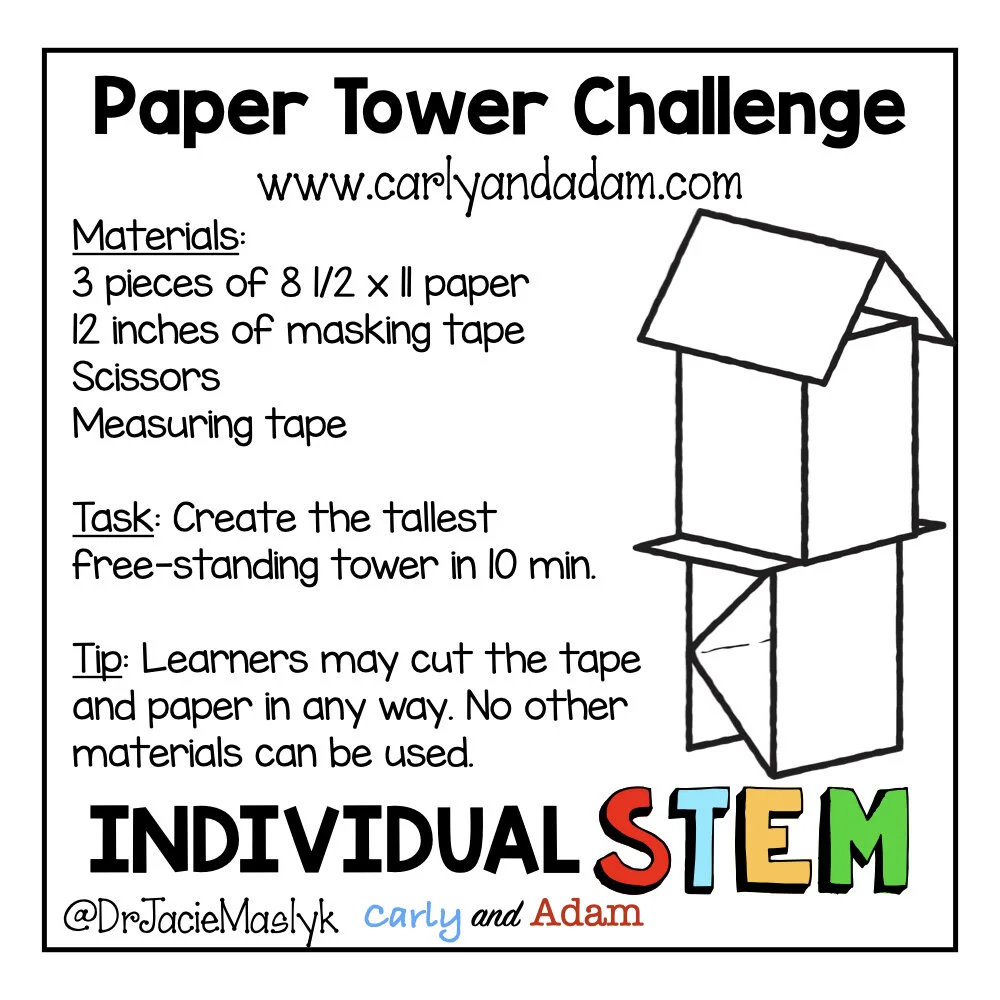
Once the time is up, students can measure their tower and record its height. Working virtually? Have students complete the challenge in a breakout room where they can share ideas with others while building independently. Then bring the whole class back together and have each student share their design on camera.

Create at least two sketches that show how you plan to use your paper plate. Share your sketches with a friend (teachers can assign breakout rooms if working virtually). Get feedback prior to building. Cut, fold, and tape your plate.
3.) Use Bulk Materials
Planning projects using shared equipment and group materials is a luxury that we may no longer have. Consider projects that use bulk materials that will be readily available to students at home or at school. As simple as it sounds, there are lots of projects that can be done with paper. (Check out these great ideas for Challenges Using Only Paper and Tape.)
Other household goods or recyclables can also be used for STEM challenges. Using materials like paper can be an inexpensive way to engage students in STEM challenges without a high cost. It also increases the likelihood that students might continue to design and redesign, replicating the challenges as they continue to participate in STEM learning outside of the school day.
If some of your students don’t have access to materials, ensure that they are included by offering home STEM kits, which can be as simple as a shoebox with some basic materials for families.
Think about general paper goods (construction paper, newspaper, index cards) and office supplies (paper clips, masking tape, pens and pencils, scissors). These might be materials that you already have available through your school.
These can also be acquired through a crowdsourcing opportunity by a parent-teacher organization or a community group. Items can be donated by parents, corporations, or other donors so that all students will have access to hands-on learning.
4.) Culmination of Learning
Whether our students are learning in school or learning virtually, we are still able to promote creativity, critical thinking, communication, and collaboration through STEM challenges.
We can find interesting projects that will engage all learners. We can offer different ways of collaborating through videos and other digital tools so that learning can be shared with others.
Spend Less Time Planning and More Time Teaching!
Hands-on STEM learning starts here.
Find ready-to-use STEM Activities and Science Curriculum, Practical Professional Development, and a Community of Educators to help you teach STEM with confidence.
You can get all 1000+ STEM Challenges by Carly and Adam as part of the STEM Teachers Club. Save 30% on your first month/year using coupon Code: CarlyAndAdamBlog.