The following is a guest post from LaTrice Lyle. You can watch her video session on this topic in The STEM Teachers Club Membership.
STEM and STEAM educators are well-versed in the 4 C’s, adopted from 21st Century education: collaboration, communication, creativity, and critical thinking. However, many of us hit a roadblock when it's time to employ a framework or model to ensure these tenets are being lived out in our classrooms each day.
There are so many models out there that we often get bogged down in the planning process instead of implementing a model to guide student learning.
But the truth of the matter is that all of these frameworks and models are interconnected and get you to the same outcome. You can think of them as the different routes our maps application may give us to get to the same destination. No matter which way we go, we are still going to arrive where we’d like to be.

Let’s continue with the analogy of traveling, shall we?
Teacher - the travel guide, the map...let’s be real its 2020...GPS or TripAdvisor
Student - the driver
Route - the framework
Destination - a student-driven, teacher-guided product
Let’s take a look at a few of the “routes” we can guide our students to take, shall we?
Inquiry-Based Learning
I like to call this model the foundation. It reminds me a lot of the foundation of a house. Pretty much every other student-centered learning model is based on it. Inquiry-based learning is a five-step cyclical process in which students are guided to ask, investigate, create, discuss, and reflect. Students can move through this process in the direction of the cycle, however; I’ve experienced that the deepest student learning happens when students do not move in a single direction, but instead, backtrack and critically think about if they are asking the right questions, creating the right solutions, etc.
Project-Based Learning
If inquiry-based learning was merely a car, Project-Based Learning (PBL) is a Mercedes Benz. I think of PBL as the fancy version of inquiry-based learning. It has the same nuts and bolts, the exterior is just much flashier. Now don’t get me wrong, PBL has and will always have a special place in my heart. It was my first introduction to the world of student-driven instruction. However, PBL is a meticulous process, one that can lead teachers to cause more harm than good if not done properly. So, if you aren’t able to be trained by a Buck Institute staff person or have a deep understanding of student-led learning, I’d start with the simpler tried and true inquiry-based learning framework.
Design Thinking Process
Admittedly, this is the framework or process I’ve used the least. Not because it isn’t a viable model, but because I personally find beauty in simplicity. The Design Thinking Process, check out this resource specifically for educators, is built on the foundation of inquiry-based learning and integrates beautifully with the 4 C’s. However, the majority of the projects I’ve seen it applied to are usually STEM-related. While this is amazing for teachers who may only teach STEM or STEM-related classes, as a general education teacher, I found it a tad more challenging to bridge the gap between ELA and social studies in a deep way.
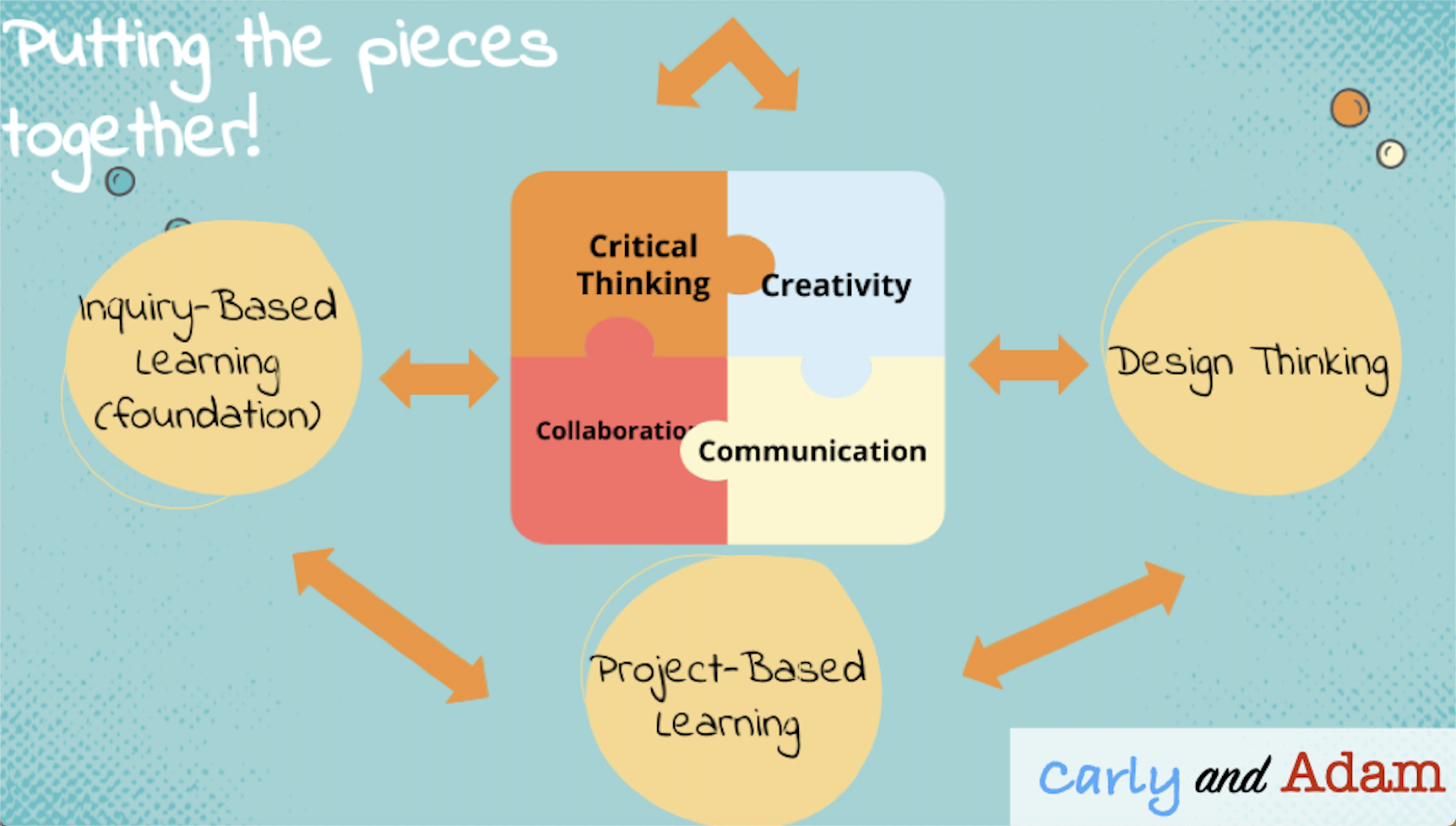
Ultimately, each of these models or routes can get you to the same destination. It's really just up to which process speaks best to your students’ learning styles, your teaching style, and the content you wish to teach. The real goal is developing learners who are capable and eager to build their own knowledge. The world needs 21st century learners who can think creatively and critically, work collaboratively, and communicate effectively.
Want more info on the 4 C’s and Inquiry-Based Learning? Get access to the full training video when you join The STEM Teachers Club Membership!

We hope you have found this blog post helpful. To stay connected with Carly and Adam's teaching tips and classroom freebies be sure to follow us on Facebook, Pinterest, Teachers Pay Teachers, and subscribe to our blog!
