
Teaching STEM Like a Chef: How to Make the Most of Your Materials
The following is a guest post from Erik Murray, a 6th grade STEM Teacher.
Rice, chicken, potatoes, broccoli, and onions. If you had these ingredients to cook dinner, what would you make? What if for some strange reason the grocery store only had those things available for a week's worth of meals? How would you change it up so that everyone at home would not complain about having the same thing for dinner again? Getting creative in the kitchen is the same as getting creative in the classroom, especially if you find yourself in a situation with limited supplies.

This was me at my first teaching job. I had no budget for STEM supplies. I only had access to what was in the storage closet. With very limited materials I created a curriculum for 4-8th graders. It was a challenging experience, but it helped me think about things differently. Thinking about teaching like you are cooking can be helpful when you see what they have in common.
The Benefits of Using a Little
Limiting the supplies is one way of thinking like a chef while teaching. The materials I had access to were 8.5 X 11 paper, Post-its, index cards, masking tape and popsicle sticks.
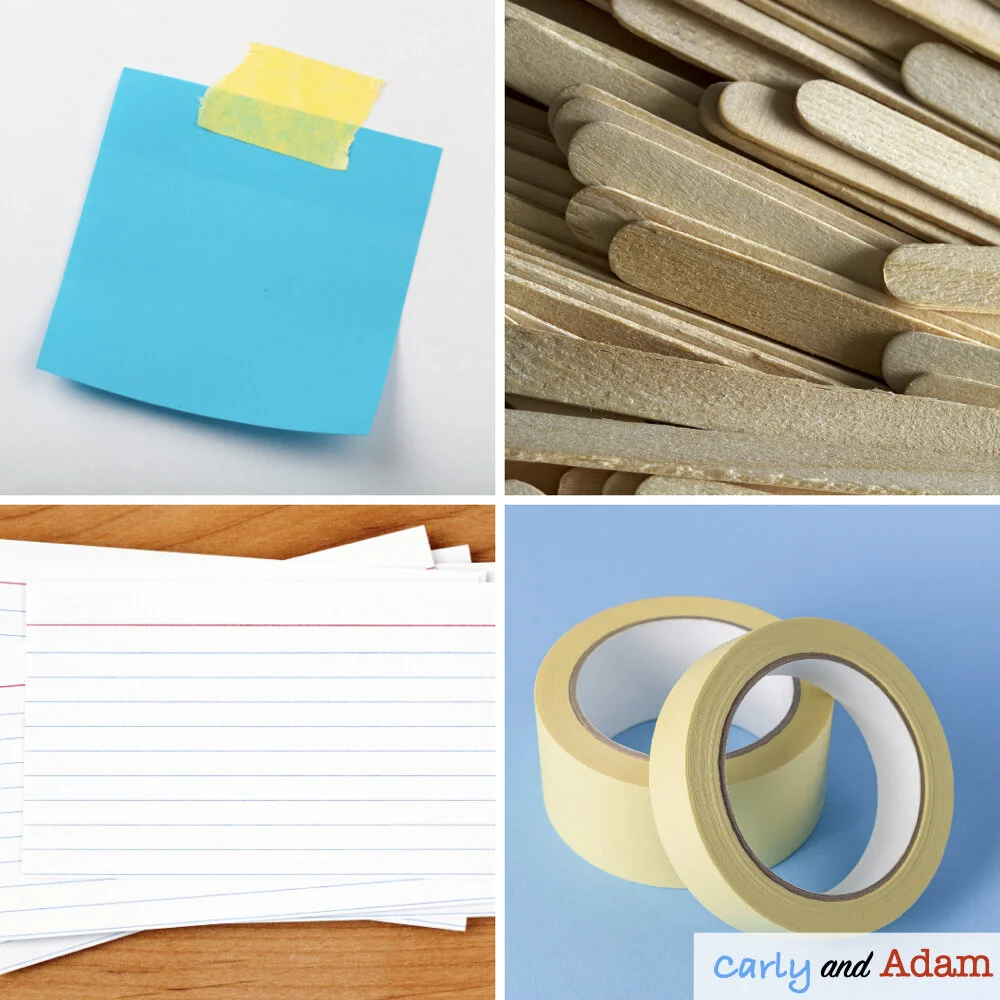
I had access to other things, but these are what I used the most. The trick is to get materials that you know you can do a lot of different things with. Using a limited amount of materials cuts down on your prep time, especially if you’re moving to different classrooms a lot.
Using the same materials in different ways is something I still do, even today. The right materials can go a long way. For example, here are 3 different ways to use a stack of Post-it notes:
A Post-it Note 3 ways
Snowball fight! Need a fun way for students to share thoughts and opinions? It’s time to have a snowball fight! When posing a question to the class, have them write their idea down on a Post-it note and crumple it up. Then, on the count of three have students throw their Post-it note. Once all Post-it notes have landed, have each student choose a random note, read the comment on it, then take turns sharing it aloud in a small group or with the whole class. Repeat this process as many times as you’d like.
The Law of Superposition. The law of superposition states that we find the older fossils deeper in the ground. I love demonstrating this with a glass and different color Post-its. I’ll pass out one color Post-it to each student have them write a note or answer a question and then crumble it up into a ball and place it into the jar. Repeat this process 3-4 times using different colors or alternating colors. At the end, show the students the jar and make observations on what they see.
Collecting data on students and teaching them about a geological process is a colorful win-win.
What do we know, what do we want to know? Post-it notes are great for brainstorming and organizing thoughts quickly. For this activity (which is a great way to start a unit) I’ll draw 3 columns on the board each with a question:
What do you know?
What do you want to know?
How can we learn?
Students will answer those questions about that topic, then stick their answer on the corresponding unit. Having their thoughts on Post-its makes it easier to organize ideas.
Great taste you can make at home.
We all love gourmet cooking and wish that we could eat like that every day. However, we don’t love the prep work, the cost, or the cleanup involved. The truth is that sometimes it’s much easier to stick with something quick and simple.
The same is true when it comes to lesson planning. It's ok to have those one or two spectacular lessons to pull out once in a while, but it’s also okay to keep things simple to help manage the stress and the materials.

Scrolling through any teacher-based social media site, or even walking around your building, you'll see all these amazing lessons put together with some pretty spectacular materials. Many of those lessons could be done with just the basics. For example, I recently saw a lesson that involved different colored light bulbs. The teacher bought different colored light bulbs and had students shine them to make different colors.
I thought this was a cool lesson, so I went searching for those types of light bulbs to use. To get a class set, it would have cost well over $500. That did not seem like a good use of money, so I went searching for a cheaper option. What I did have was some old Christmas lights, AA batteries, and some wire strippers.
I cut down the Christmas lights to individual lights and used the batteries to power them up. This became one of my most effective lessons all year. Students were playing with the lights, mixing colors, running them through different filters, and even observing the changes different batteries had on the bulbs. Taking inspiration from something I saw, I was able to duplicate it with the materials I had in order to create the outcome I wanted.

If I did this the way I saw on the internet, it would have been over $500. This way I did it with the supplies I had on hand.
This is boring... time to add some ketchup!
We’ve all been there before, scrambling to get a lesson together. You get ready to teach and you're excited to see what's going to happen. Halfway through the introduction a student blurts out “I’ve done this before” throwing you off along with the rest of the class. This can be such a deflating experience.
But, with some slight tweaks, a project can be completely changed. Thinking back to when I was young and my mom was cooking. She would make something and then someone would shout that it was boring or we had that already. She would add a little bit of ketchup to change up the food to make it a little less boring. You can add a little bit of ketchup to your lesson by adding some probability.

For example, let’s say your activity is to build the tallest tower out of 2 pieces of paper and 10 inches of tape. Half the class pipes up and says that they’ve done this before and it's boring. Time to add a little ketchup to change it up.
One way to do this is to have the class brainstorm 6 different ways we could change the challenge. Things like no tape, survive the table being shook, survive being sprayed with water, or no scissors. Then, roll a dice and whatever number corresponds to the challenge, the selected is what they have to do. You have a completely different challenge with the same materials.

Closing Thoughts
When it comes to teaching STEM you don’t need a lot of stuff to be an engaging teacher. Like cooking, STEM education is a mixture of the world around us. Inspiration can come from anywhere and it’s all about the skill of putting things together.
Bon Appetit!