Water is one of the simplest ways to get Pre-K students engaged in real science thinking. In this sink-or-float challenge, students test everyday objects in a tub of water and sort what they observe into two clear categories: sink or float.
The structure is predictable and repeatable—students make a quick prediction, run a test, then talk about what happened—so they can focus on noticing patterns instead of trying to remember complicated directions. It also naturally builds early vocabulary (heavy/light, top/bottom, wet/dry) and supports key classroom skills like taking turns, waiting, and explaining their ideas out loud.

This Pre-K sink-and-float challenge helps students practice basic science skills: predicting, testing, observing, and sorting. It’s easy to set up and works well as a small-group activity or center.
Connecting to Row, Row, Row Your Boat
You can connect the investigation to “Row, Row, Row Your Boat” by using the song as a quick, familiar launch. Start by singing it together (or listening once), then ask a simple question: “Boats stay on top of the water—what helps a boat float?”

Explain that students will test different objects to see which ones float like a boat and which ones sink. You can also add a brief follow-up: “If something sinks, would it make a good boat? Why or why not?” That link keeps the activity grounded in a shared classroom reference and gives students a clear reason for the testing and sorting they’re about to do.
Steps
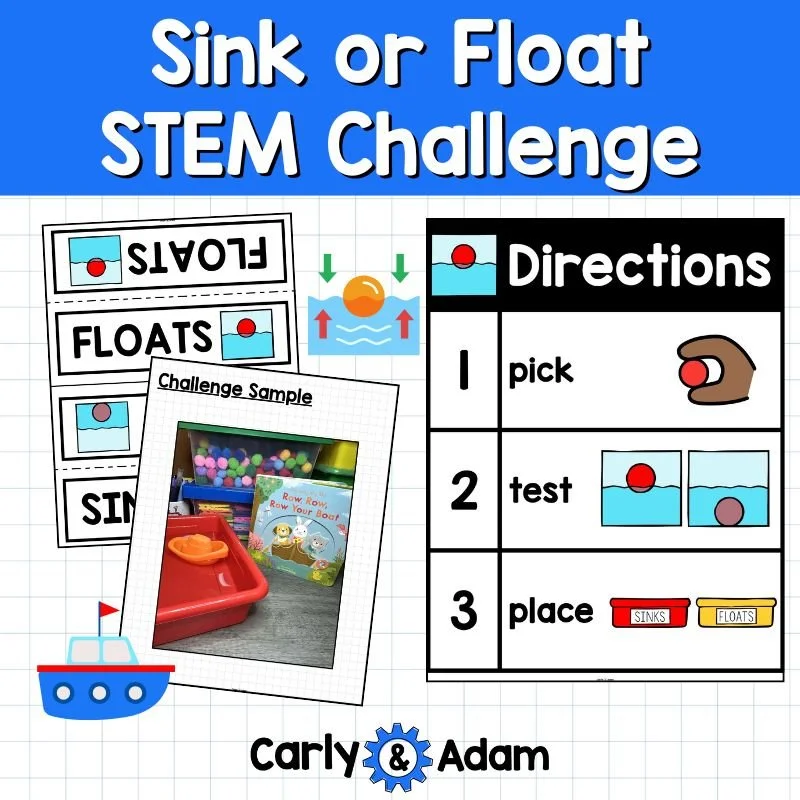
Show an object and ask: “Will it sink or float?”
Students test it in the water.
Students sort it into “Sink” or “Float” categories.
Repeat with additional objects.
Extension
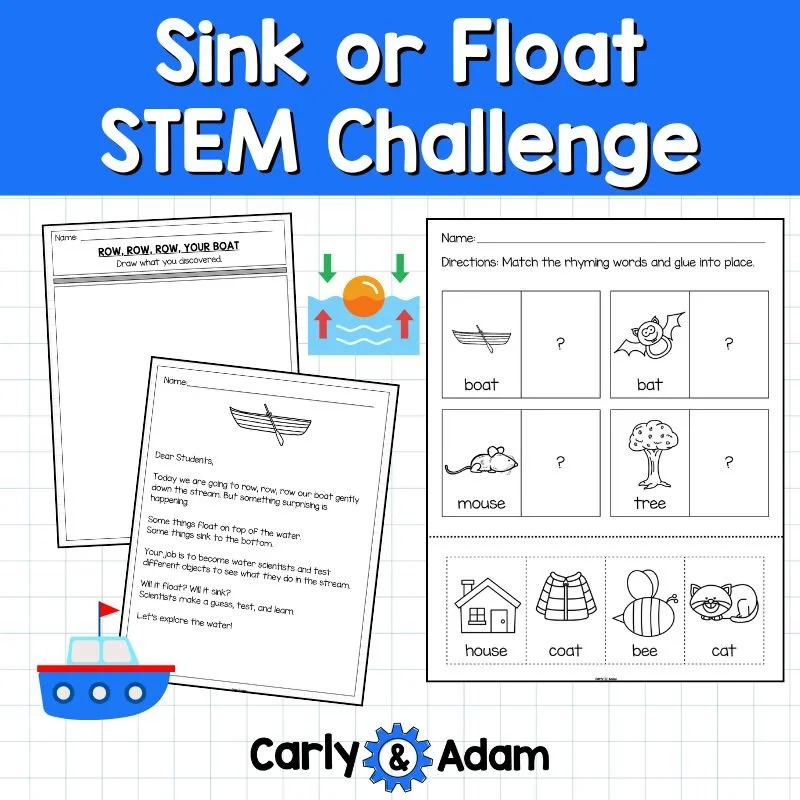
Add a simple recording page: draw one item that sank and one that floated.
Connect to literacy with a quick rhyming activity (optional).
What students learn
This challenge works well because it’s simple enough for Pre-K, but still builds real science habits. Students aren’t just “playing in water”—they’re practicing how to make a prediction, test it, and use evidence from what they saw to sort and talk about results. Run it once as a guided lesson, then keep it available as a center so students can repeat the process with new objects and refine their thinking over time.
To close, bring the class back together to share a few examples of items that sank and floated and ask what students noticed about them. That quick discussion helps students connect individual tests into bigger ideas, and it gives you an easy way to assess understanding through their explanations.
Spend Less Time Planning and More Time Teaching!
Hands-on STEM learning starts here.
Find ready-to-use STEM Activities and Science Curriculum, Practical Professional Development, and a Community of Educators to help you teach STEM with confidence.
You can get all 1000+ STEM Challenges by Carly and Adam as part of the STEM Teachers Club. Save 30% on your first month/year using coupon Code: CarlyAndAdamBlog.