
7 Steps for Building a STEM Culture in your Classroom
The following is a guest post from Chris Woods.
You can watch his Video Session on this topic in The Elementary STEM Teachers Club Membership.
7 Steps for Building a STEM Culture in your Classroom
Let’s start with a story…
I have a student (and maybe you have one like this, too) who enjoys making and creating, and designing. He would routinely tell me about things he was working on when we were remote learning in 2020. Once we started back in school in early 2021, it became the norm to see him drawing something with a geometric spin or leaving behind a new origami design on his desk after class. And when I showed my students how Tinkercad allowed anyone to design things for 3d printing, he became one of the most frequent users in the class. He didn’t always finish all of his assignments, but his artistic abilities combined with the STEM culture of my classroom opened up new opportunities for learning. I’m convinced that going forward he’s going to do incredible things in life!

Every year, more and more schools are starting STEM programs with the goal of helping kids do more STEM and prepare them for incredible futures. That’s exciting! Kids love the fun, messy, noisy, collaborative, practical, and hands-on nature of STEM. Building these into our classrooms on a daily basis engages kids much more than traditional assignments and assessments ever could.
So, are you at a school that has taken a leap into STEM learning?
Has it gone smoothly?
Could it be better?
Are you wondering how to make it better?
Or just wondering how to make it more than it currently is?
Think for a moment about these typical steps schools follow when they start building a STEM program:
Administration/District decides to add a STEM program
A STEM teacher/coordinator is hired
STEM teacher/coordinator gets a budget to spend on STEM Supplies
STEM teacher/coordinator starts a STEM class
Lots of kids enjoy STEM class
STEM teacher/coordinator keeps searching for new STEM resources/projects/ideas
All the other teachers love it when kids go to STEM class
While these steps can lead to a quality STEM program at a school, they tend to “put the cart before the horse.” They often leave STEM teachers/coordinators overwhelmed and “regular” teachers wondering how to get involved in the STEM program.

After talking with hundreds of STEM teachers and innovators, I can say with absolute certainty that the following seven steps can help you build a sustainable, holistic, integrated STEM culture in any school and every classroom.
1.) Find your why (what’s your reason for adding STEM)
Before you even start the “what” or “how” of STEM in your school and classroom, you need to know your “why.” Don’t start STEM because “everybody’s doing it” or just because the world is hi-tech. Spend time brainstorming some reasons why STEM is important that are both specific and accessible.
If you’re going to build a culture of STEM learning in your classroom, practical has to precede technical. Don’t confuse yourself (or the kids) with jargon and fancy edu-speak. You can even ask kids and parents to help craft your mission, goal, or keywords to guide STEM learning in your school. And if it helps you remember, display it somewhere to keep it foremost in your efforts every day (bonus STEM points if you make it from recycled materials or have the kids design it).
For me, my motivation for STEM is always about the kids. Every kid, every class, every day deserves the best educational opportunity I can give them. A culture of STEM learning provides that.

2.) Learn from others (down the hall or around the world)
Once you know why you’re doing STEM with your kids, it’s now time to start figuring out how to do STEM effectively. Although STEM has gained in popularity, there’s still a good chance that there’s only one STEM teacher or coordinator at your school. That makes it imperative to reach out to other “early adopters” in your school or STEM “experts” around the world.
Don’t be afraid to ask questions. Educators may be busy, but they’re always willing to help if it means that more kids get excited about learning. In your school, you have colleagues with unique talents and interests that can help you bring new STEM ideas to your kids. And thanks to that phone in your pocket, there are STEM conferences, podcasts, blogs, social media, Twitter chats, and websites at your fingertips to learn from too.

3.) Build it up (start adding STEM resources & ideas to your lessons)
Now that you’re excited and have some budding confidence for adding STEM to your classroom, it’s time to start fine-tuning your game. Practice makes perfect, and for anyone who has been a teacher, you know that there are plenty of opportunities to try new things, fight through failures, and build successful learning in the classroom.
We as educators need to model a growth mindset with our kids.
Try that new resource you saw on a website.
Give that experiment you saw on YouTube a go in your classroom.
Search #STEM or #STEAM hashtags or participate in a #PrimarySTEMchat on Twitter.
Look for good STEM Facebook groups to learn from. Make time for that great idea you saw at a conference years ago that you always wanted to try with your kids. And don’t forget to evaluate what you tried to determine how to make it better next time, or if you should scrap it and try something completely different. We can’t just talk about the iteration in the scientific method, rough drafts, and engineering design process, we need continuous improvement in education too.

4.) Share your success (let your colleagues & community know what you’re doing)
If a tree falls in the woods, and no one hears it, does it make a sound?
Likewise, if you’ve tried a great STEM challenge with your kids, and they did a super job, but you don’t tell anyone about it, did it actually happen?
STEM learning should not happen in a vacuum. When your kids do or create something amazing, they need to know they didn’t just do it to “get a grade.” Sharing pictures and videos of what your kids are learning validates the quality of their work. It also has the benefit of helping parents ask their kids better questions about what they learned in school if they’ve seen pictures of the learning.
And when other teachers see the things you post on the school’s social media or see the projects the kids have made on display in the hallways, they’ll start asking how they can do something like that. Be sure to keep in mind privacy issues at your school when sharing, but sometimes just taking a picture of a kids’ hands making something has made my students feel extra special and build confidence in their abilities.

5.) Listen to your students (build off their interests & passions)
Once you’ve started adding STEM to your classroom and school, it’s easy to get in a rut and start doing the same projects, ideas, and challenges over and over again. That’s where adding student voice and input come to the rescue.
Repurpose a bulletin board or unused chalkboard by writing in big letters “What do we want to learn about?” with room for students to put ideas underneath.
Show pictures of STEM you see in your daily life and ask kids to share what they see.
Turn “Show & Tell” into “STEM & Tell.”
Build next-step opportunities for extension into every project and challenge you do, so that kids can keep learning long after the lesson “ends.” Leveraging kids’ passions builds new levels of engagement.

6.) Connect with home (get kids learning STEM with their families)
If the classroom is the new frontier of STEM learning, the home was the original frontier. Kids for centuries have helped cook dinner and mend clothes, explored their backyards and neighborhoods, built forts and lemonade stands, and played games together with their families.
If we want to double the impact of STEM learning, the real key is to reinvest in STEM at home. Too many parents think that STEM is all rocket science and 3D printing (yes, both cool STEM). We need to make it practical and easy again.
Provide families with simple ideas that make STEM accessible for every family no matter what resources they have at home. We’ve told families to read to their kids, now it’s time to help them do STEM with their kids. And it can be as simple as watching a movie like Queen of Katwe together, then learning how to play chess. Or going for a walk and picking up litter together, then discussing how daily purchases could be more sustainable.
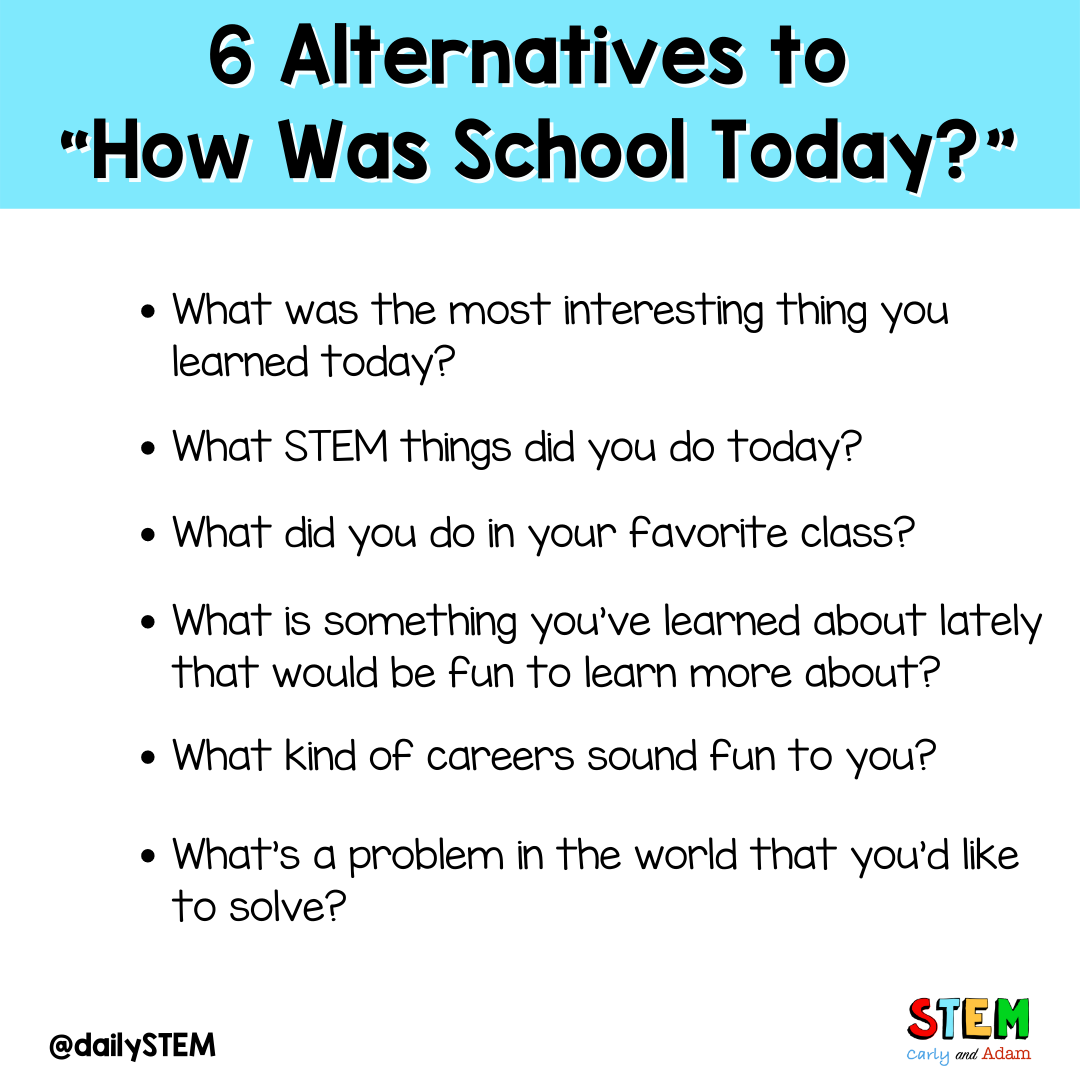
And don’t forget the sharing part from before. Ask your kids “what STEM did you do at home this past weekend?” Maybe some of the stories shared will inspire that next classroom challenge.
7.) Keep learning (find and adapt new ideas)
Once you’ve started doing STEM, keep going. It’ll be tempting to rest on your laurels and the notoriety that becoming a “STEM leader” can bring. Try to help every teacher in your school, especially the hesitant ones, add just a little STEM every day. Offer to work with them on a STEM lesson. Collaborate on a project involving both of your classes. Build some mobile STEM resource carts. Advocate for more elective classes.
To build a STEM culture, it needs to be ingrained in every classroom every day, not just the “STEM Classroom.” Your confidence will grow each time you talk about or add STEM in your daily lesson plan, and it will rub off on those around you. I’ve been teaching for over 20 years and I still learn and share new STEM ideas every day. My students and your students deserve the best learning opportunities we can give them.
Our world is advancing every day. STEM learning provides the opportunities to level the playing field for every kid in your classroom and community.

Here’s one final story.
Another student in my class this year loved to paint. On our first day of face-to-face learning in January, she brought me a painting she had done of Ferb (from the best STEM cartoon of all time Phineas & Ferb).
I thanked her and continued asking her about what she was painting over the next few months. One day I read a story about Ellen Ochoa, the first female Hispanic astronaut. I asked my student if she could paint the four mission patches from Astronaut Ochoa’s missions, and she gladly agreed. I even found Ms. Ochoa’s email address and asked if she would be willing to send a signed photo to our class.
When the photo arrived, I let my artist student open the envelope. Needless to say, my student has been inspired. She knows that her talents can open up opportunities, in art or STEM, and that the sky's the limit for her and her classmates.
Find More Ideas for Building a STEM Culture in Your Classroom in the book Daily STEM .

Want more tips for building a STEM culture in your classroom? Get access to the full training video when you join The STEM Teachers Club Membership!

We hope you have found this blog post helpful. To stay connected with Carly and Adam's teaching tips and classroom freebies be sure to follow us on Facebook, Pinterest, Teachers Pay Teachers, and subscribe to our blog!
