The Legend of Sleepy Hollow Pumpkin Catapult STEM Challenge for Fall and Halloween
Looking for a fall STEM activity that gets students building, testing, and talking about their ideas?
This Pumpkin Catapult STEM Challenge turns simple classroom supplies into a hands-on engineering experience. You can get all of the worksheets in Carly and Adam’s store or become a STEM Teachers Club Member and download it for FREE!
Students design a catapult, launch a candy pumpkin or pumpkin manipulative, and measure how far it travels.

Launch into fall learning with this Pumpkin Catapult STEM Challenge!
Elementary students design and build a popsicle stick catapult, launch a pumpkin, and measure the results. Connect Halloween STEM activities with The Legend of Sleepy Hollow or pair your pumpkin STEM lesson with How Big Could Your Pumpkin Grow?
A hands-on way to practice engineering, problem-solving, teamwork, and measurement. Save this idea for your October STEM plans!
It’s a fun way to bring pumpkin STEM activities into your October plans while connecting science, math, teamwork, and literacy. Pair it with The Legend of Sleepy Hollow for a Halloween connection, or keep the focus on pumpkins for a seasonal engineering challenge.

Introduce your next Halloween STEM challenge with editable Canva lesson slides!
This Pumpkin Catapult STEM Challenge includes presentation materials to introduce the task and support your fall engineering lesson. Students plan, build, and test a pumpkin launcher using simple supplies.
Pair the activity with The Legend of Sleepy Hollow for a read-aloud STEM connection that brings science, literacy, and creative problem-solving together.
Gather Your Catapult Materials
The lesson suggests these building supplies for each team:
4 rubber bands
2 large popsicle sticks
6 small popsicle sticks
1 plastic spoon
You’ll also need candy pumpkins or pumpkin manipulatives for launching. Have rulers or measuring tapes available so students can measure their results.
Set up a clear launch area with everyone launching in the same direction, away from classmates. Establish a starting line so teams have a consistent place to measure from.
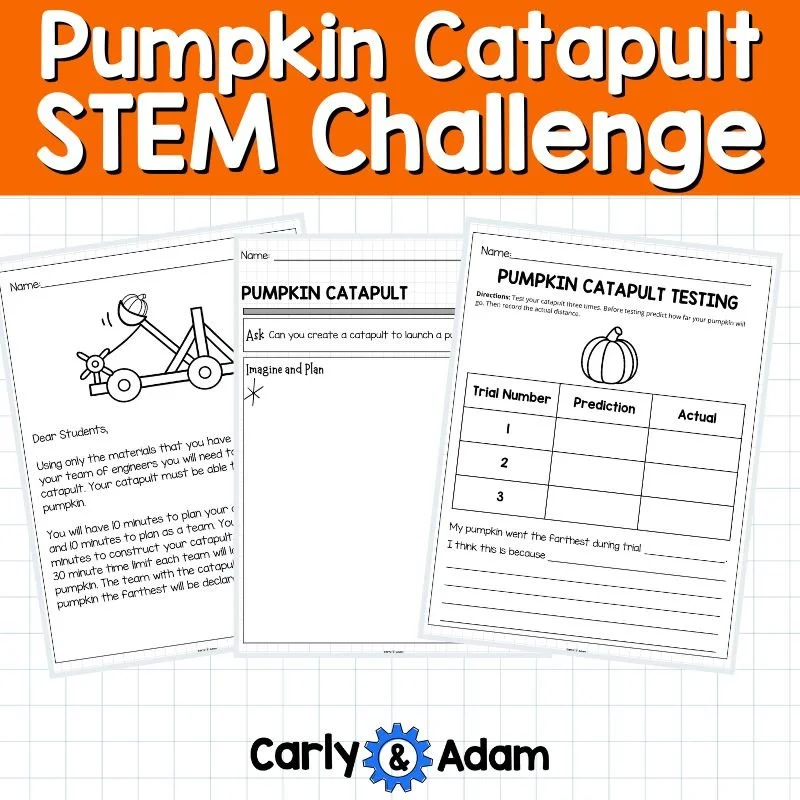
Combine fall STEM and math with a Pumpkin Catapult STEM Challenge!
Students sketch their engineering ideas, build a pumpkin launcher, and record predictions and actual distances across three trials. These student pages help elementary learners organize their thinking and use test results to discuss their designs.
Save this pumpkin activity for October STEM lessons, Halloween classroom activities, or hands-on measurement practice.
Plan Before Building
Give students time to imagine and sketch their own catapult designs before they meet with their teams. The included planning pages prompt them to think about how they will use the materials, how they might launch the pumpkin farther, and what problems could come up during construction.
Next, have teammates share their ideas and create a team plan. This gives students practice explaining their thinking, listening to others, and combining ideas.
Although the resource includes sample catapult designs for teachers, let students explore their own solutions. A design that needs adjusting creates a useful opportunity to solve a problem.
Build and Test the Pumpkin Catapults
Once teams have a plan, it’s time to build! Encourage students to divide responsibilities and help one another work through challenges. If a design tips over or the pumpkin drops straight down, ask students what they notice and what they could change.
The lesson includes a recording sheet for three test launches. Before each launch, students predict how far their pumpkin will travel. Afterward, they measure and record the actual distance.
These trials give measurement a purpose. Students can compare predictions with results, identify their farthest launch, and discuss why the distances might differ.
For a fair comparison, encourage teams to use the same starting line and pumpkin throughout their tests. When they redesign, suggest changing one feature at a time so they can better understand its effect.
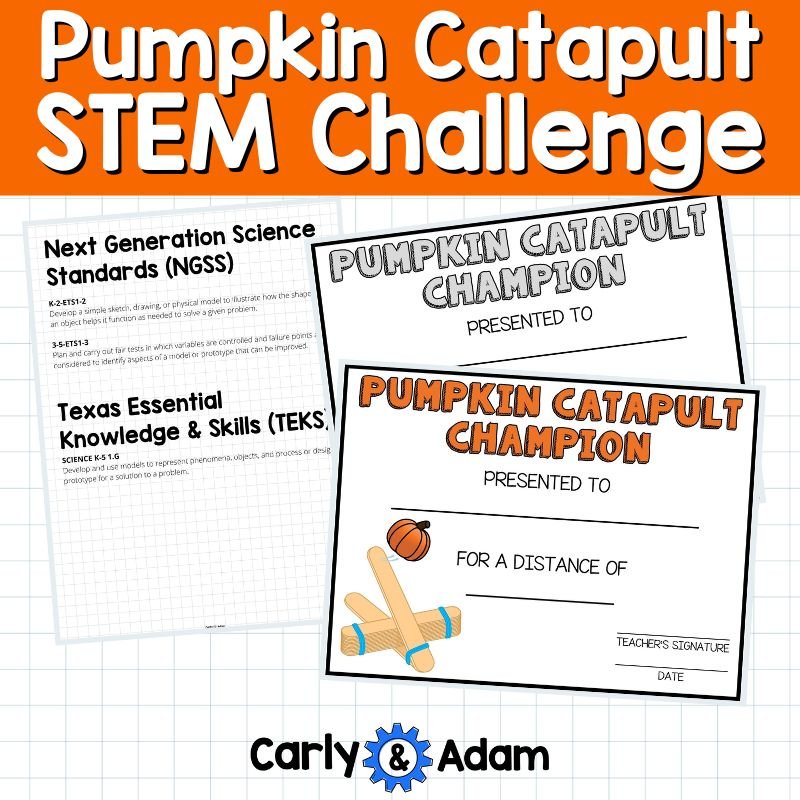
Celebrate student engineering with a Pumpkin Catapult STEM Challenge!
Elementary students build launchers, measure pumpkin launch distances, and reflect on their designs. The resource includes NGSS and TEKS connections plus optional Pumpkin Catapult Champion certificates. Add this fall STEM activity to your Halloween lesson plans for a playful way to practice testing, measurement, teamwork, and design improvement.
Explore the Science Behind the Launch
A pumpkin catapult helps students see stored energy in action. Bending parts of the catapult stores potential energy. When students release the launcher, that stored energy helps send the pumpkin into motion. Gravity pulls it back toward the ground.
The resource includes vocabulary cards for catapult, potential energy, force, and gravity, along with a science explanation. Connect these words to what students observe as they test.
Ask questions such as:
What happens when you press the launcher down and release it?
What keeps your catapult steady?
What could you change to help the pumpkin travel farther?
What evidence shows that your change helped?
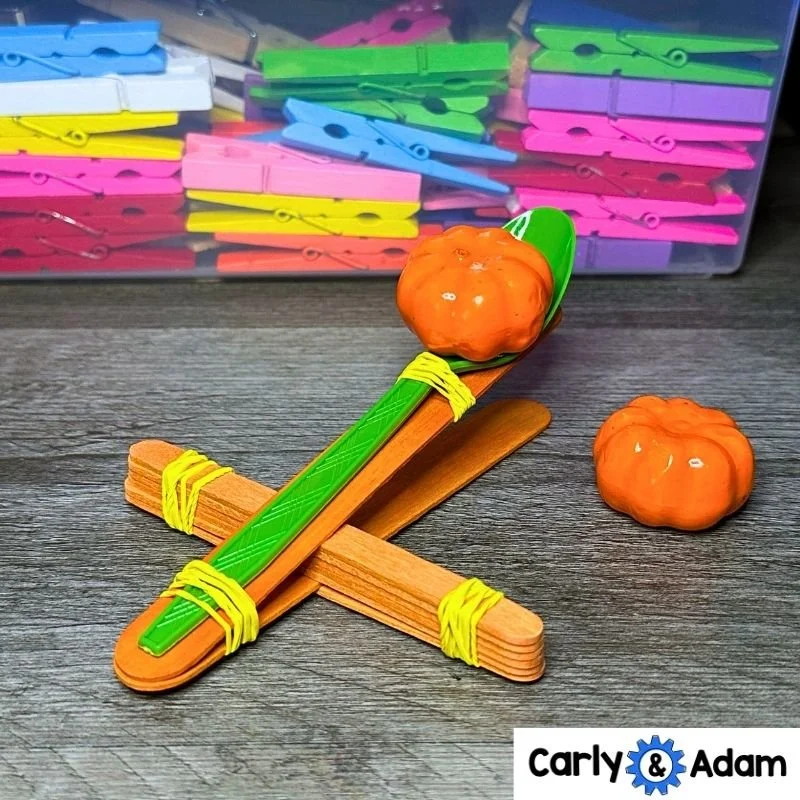
Turn popsicle sticks, rubber bands, and a plastic spoon into a pumpkin launcher!
This pumpkin catapult activity challenges elementary students to build, test, and improve their own designs. Students explore potential energy, force, and gravity while predicting and measuring launch distances.
Add this fall STEM challenge to your pumpkin unit, Halloween activities, or elementary STEM lab for hands-on engineering with simple materials.
Make Time to Improve and Reflect
Leave time for teams to adjust their designs and test again.
Remind students that engineering involves learning from what happens, including launches that don’t go as planned.
The reflection page asks students to explain what worked well, what they would do differently, and how their group worked together. The included Pumpkin Catapult Champion certificates offer an optional way to recognize the farthest launch. You can also celebrate persistence, thoughtful improvements, and teamwork.
Add a Flying Pumpkin Writing Activity
Keep the learning going with the included creative writing prompt. Students imagine seeing a pumpkin flying through the air and write about where it came from, where it lands, and what happens next.
This extension gives students a chance to turn their engineering experience into a story. After measuring real launches, they can imagine a pumpkin taking a much more surprising journey!
Bring the Pumpkin Catapult STEM Challenge to Your Classroom
Carly and Adam’s Pumpkin Catapult STEM Challenge includes teacher instructions, a link to Canva lesson slides, engineering design process posters, vocabulary cards, a science explanation, planning and testing pages, reflection questions, a creative writing activity, and optional champion certificates.
Add it to your fall STEM lessons or Halloween classroom activities to give students a reason to build, measure, revise, and share their thinking. With a few simple supplies, your students can put their engineering ideas to the test—one pumpkin launch at a time.
Spend Less Time Planning and More Time Teaching!
Hands-on STEM learning starts here.
Find ready-to-use STEM Activities and Science Curriculum, Practical Professional Development, and a Community of Educators to help you teach STEM with confidence.
You can get all 1000+ STEM Challenges by Carly and Adam as part of the STEM Teachers Club. Save 30% on your first month/year using coupon Code: CarlyAndAdamBlog.